



by Plinio Corrêa de Oliveira
Debts should be paid at the first opportunity. I mention this truism to apologize. In my second-to-last article, I said I would soon discuss a certain topic. Then, the issue of adverse possession and the obligations from my past—both distant and recent—regarding this subject compelled me to write about it right away. My nearly overwhelming current workload has kept me from writing for the Folha, so I now feel a bit guilty and want to make up for the delay by returning to the topic I mentioned.
In my article “Modern, Forward-Thinking, in the Wind” (Folha de S. Paulo, 10/24/1981), I discussed the deep change occurring across significant sectors of American society. Truly profound, because it impacts a psychological realm that shapes language, clothing, manners, housing choices, as well as objects of utility and decoration, the way Americans confront internal and external issues, and how they choose candidates for all elected offices — from a small-town city councilor in a remote part of the country to candidates for the House, Senate, or even the presidency.
In more concrete terms, the reasons many Americans preferred Reagan over Carter now lead us to choose wooden furniture in a traditional, delicate style rather than Formica. To wear a jacket and tie, setting aside the sleeveless T-shirt. To wash, cut, and comb one’s hair, which until recently was left to the winds… and insects. Using language and personal mannerisms marked by refinement, instead of the “spontaneity” or “relaxed attitude” that until recently were considered vulgar and sloppy. And note, dear reader, that in terms of clothing, I have only mentioned men’s attire because, when it comes to women’s clothing, I would naturally need to elaborate much more.
Objective minds wanting to stay current with the latest trends in modernity can’t ignore that this now includes exactly the nation that holds the reins of “modernity.”
Unfortunately, information on this subject has been limited in our country. However, it has recently been addressed comprehensively and thoroughly in a well-documented manner through a special issue on the topic published in Catolicismo, the outstanding monthly cultural magazine founded by the distinguished Bishop Antônio de Castro Mayer and skillfully edited by Prof. Paulo Corrêa de Brito Filho (Nos. 368-370, August-October 1981).
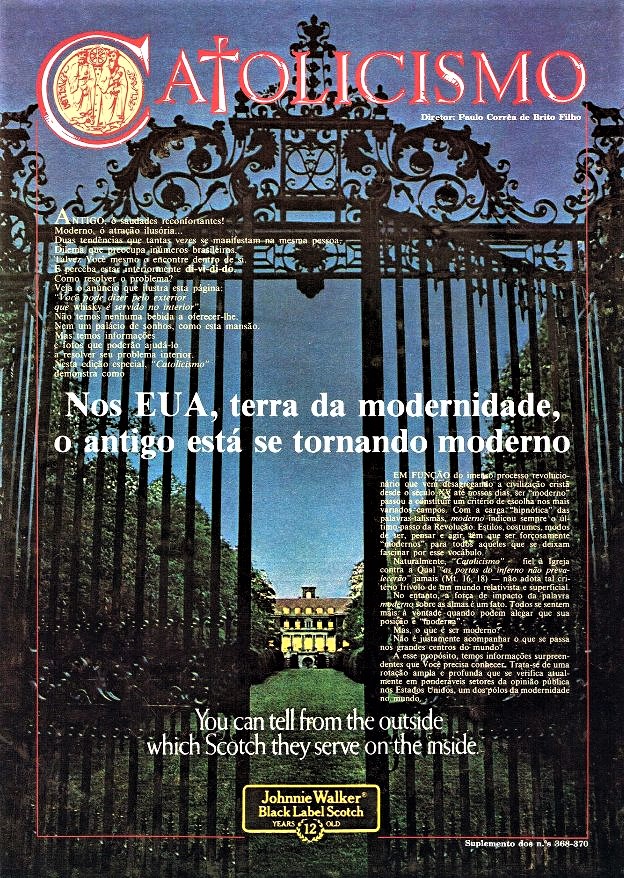
I will now share some of the information provided by Catolicismo.
Under the title “Language Lib,” William Safire commented in The New York Times Magazine on March 1, 1981: “As Americans yearned for the old standards and values, both the politics of language and the language of politics became more conservative. As a literate public became happily aroused, permissivism became a dirty word. ‘Anything goes’ no longer went.”[1]
Sensitive to this new wave, which greatly benefited his election, “Reagan has been as meticulous in his dress as he has been with his use of language. … What men of power sometimes forget is that they are creations of other times and other events and other people. Dignity is a demonstration that they understand, and that they pay special tribute to as something beyond themselves.”[2]
In line with this shift, basic rules have been reinstated at the White House: a “dress code” and “rules of etiquette” are now enforced (“Let Them Eat Cake—But Not at Their Desks,” Newsweek, 9/2/81).
Here are some examples: a) blue jeans were banned; b) women’s pants were also banned; c) jackets and ties became mandatory for men; d) contrary to the previous custom of calling people by their first names, the use of “Mister” was restored; e) porcelain cups replaced plastic cups; f) employees were prohibited from eating snacks in the workrooms; g) the press room was organized: journalists must “remain seated, raise their hands, and wait their turn” during interviews. “Despite their habit of jumping up and shouting, the press corps complied—a well-mannered start to a new era of politeness,” comments Newsweek magazine; h) another change is the civility of the employees: White House Director Baker commented that they are a symbol for the nation and, therefore, need to behave appropriately, even when they are not on duty (Time, 3/9/81); i) in the Armed Forces, the rules of courtesy, presentation, and military discipline have returned.
What impact did these events have on the people? Let’s hear from one representative voice: “In 1976, we saw a presidential inauguration with ordinary leather shoes, work suits, and worn clothes, and four years later we witnessed the spectacle of large limousines, tailcoats, and gala dresses. The contrast is much more significant than a matter of personal taste. It signals a fundamental conflict of social values!” says Rosalind Williams of the Massachusetts Institute of Technology, MIT (The New York Times, February 25, 1981).
For this very reason, and along these lines, the atmosphere in the White House has shifted. Everything is in order, a thorough cleaning has been done, and the paint has been refreshed (cf. Time, March 9, 1981).
* * *
Only frivolous minds can argue that such changes in the building where the nation’s highest leadership operates, and others introduced by a newly elected president eager to align with the nation, are insignificant. Conversely, they represent a positive transformation in the core values of very important sectors of the country. This will become even clearer when we consider the admirable strengthening of family values that has been occurring in these same sectors.
Aware of our audience’s interest in these matters, I plan to address them in my next article… when I hope circumstances will allow me to avoid being a deadbeat.
[1] https://www.nytimes.com/1981/03/01/magazine/on-language-language-lib-by-william-safire.html#:~:text=There%20you%20have%20the%20opening,to%20non%2DEnglish%20language%20movies.
[2] “The Presidency: Demonstrations of Dignity,” Time, 3/9/1981. https://time.com/archive/6854865/the-presidency-demonstrations-of-dignity/