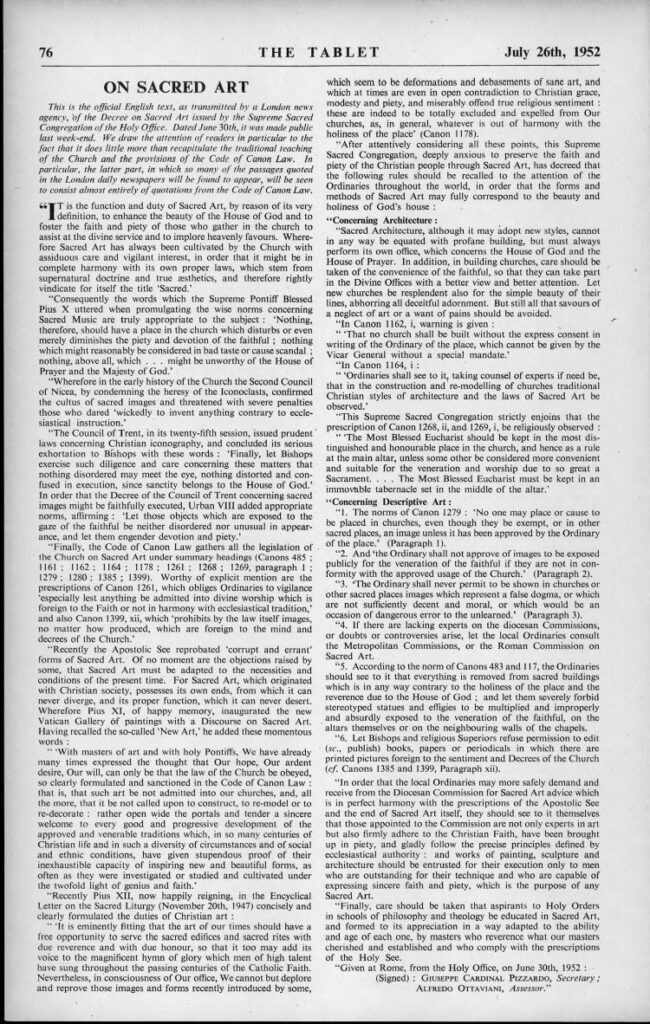
The Tablet, London, July 26th, 1952, p. 76.
ON SACRED ART
This is the official English text, as transmitted by a London news agency, of the Decree on Sacred Art issued by the Supreme Sacred Congregation of the Holy Office. Dated June 30th, it was made public last week-end. We draw the attention of readers in particular to the fact that it does little more than recapitulate the traditional teaching of the Church and the provisions of the Code of Canon Law. In particular, the latter part, in which so many of the passages quoted in the London daily newspapers will be found to appear, will be seen to consist almost entirely of quotations from the Code of Canon Law.
“It is the function and duty of Sacred Art, by reason of its very definition, to enhance the beauty of the House of God and to foster the faith and piety of those who gather in the church to assist at the divine service and to implore heavenly favours. Wherefore Sacred Art has always been cultivated by the Church with assiduous care and vigilant interest, in order that it might be in complete harmony with its own proper laws, which stem from supernatural doctrine and true aesthetics, and therefore rightly vindicate for itself the title ‘Sacred.’
“Consequently the words which the Supreme Pontiff Blessed Pius X uttered when promulgating the wise norms concerning Sacred Music are truly appropriate to the subject: ‘Nothing, therefore, should have a place in the church which disturbs or even merely diminishes the piety and devotion of the faithful; nothing which might reasonably be considered in bad taste or cause scandal; nothing, above all, which … might be unworthy of the House of Prayer and the Majesty of God.’
“Wherefore in the early history of the Church the Second Council of Nicea, by condemning the heresy of the Iconoclasts, confirmed the cultus of sacred images and threatened with severe penalties those who dared ‘wickedly to invent anything contrary to ecclesiastical instruction.’
“The Council of Trent, in its twenty-fifth session, issued prudent laws concerning Christian iconography, and concluded its serious exhortation to Bishops with these words: ‘Finally, let Bishops exercise such diligence and care concerning these matters that nothing disordered may meet the eye, nothing distorted and confused in execution, since sanctity belongs to the House of God.’ In order that the Decree of the Council of Trent concerning sacred images might be faithfully executed, Urban VIII added appropriate norms, affirming: ‘Let those objects which are exposed to the gaze of the faithful be neither disordered nor unusual in appearance, and let them engender devotion and piety.’
“Finally, the Code of Canon Law gathers all the legislation of the Church on Sacred Art under summary headings (Canons 485; 1161; 1162; 1164; 1178; 1261; 1268; 1269, paragraph 1; 1279; 1280; 1385; 1399). Worthy of explicit mention are the prescriptions of Canon 1261, which obliges Ordinaries to vigilance ‘especially lest anything be admitted into divine worship which is foreign to the Faith or not in harmony with ecclesiastical tradition,’ and also Canon 1399, xii, which ‘prohibits by the law itself images, no matter how produced, which are foreign to the mind and decrees of the Church.’
“Recently the Apostolic See reprobated ‘corrupt and errant’ forms of Sacred Art. Of no moment are the objections raised by some, that Sacred Art must be adapted to the necessities and conditions of the present time. For Sacred Art, which originated with Christian society, possesses its own ends, from which it can never diverge, and its proper function, which it can never desert. Wherefore Pius XI, of happy memory, inaugurated the new Vatican Gallery of paintings with a Discourse on Sacred Art. Having recalled the so-called ‘New Art,’ he added these momentous words:
“‘With masters of art and with holy Pontiffs, We have already many times expressed the thought that Our hope, Our ardent desire, Our will, can only be that the law of the Church be obeyed, so clearly formulated and sanctioned in the Code of Canon Law: that is, that such art be not admitted into our churches, and, all the more, that it be not called upon to construct, to re-model or to re-decorate: rather open wide the portals and tender a sincere welcome to every good and progressive development of the approved and venerable traditions which, in so many centuries of Christian life and in such a diversity of circumstances and of social and ethnic conditions, have given stupendous proof of their inexhaustible capacity of inspiring new and beautiful forms, as often as they were investigated or studied and cultivated under the twofold light of genius and faith.’
“Recently Pius XII, now happily reigning, in the Encyclical Letter on the Sacred Liturgy (November 20th, 1947) concisely and clearly formulated the duties of Christian art:
“‘It is eminently fitting that the art of our times should have a free opportunity to serve the sacred edifices and sacred rites with due reverence and with due honour, so that it too may add its voice to the magnificent hymn of glory which men of high talent have sung throughout the passing centuries of the Catholic Faith. Nevertheless, in consciousness of Our office, We cannot but deplore and reprove those images and forms recently introduced by some, which seem to be deformations and debasements of sane art, and which at times are even in open contradiction to Christian grace, modesty and piety, and miserably offend true religious sentiment: these are indeed to be totally excluded and expelled from Our churches, as, in general, whatever is out of harmony with the holiness of the place’ (Canon 1178).
“After attentively considering all these points, this Supreme Sacred Congregation, deeply anxious to preserve the faith and piety of the Christian people through Sacred Art, has decreed that the following rules should be recalled to the attention of the Ordinaries throughout the world, in order that the forms and methods of Sacred Art may fully correspond to the beauty and holiness of God’s house:
Concerning Architecture:
“Sacred Architecture, although it may adopt new styles, cannot in any way be equated with profane building, but must always perform its own office, which concerns the House of God and the House of Prayer. In addition, in building churches, care should be taken of the convenience of the faithful, so that they can take part in the Divine Offices with a better view and better attention. Let new churches be resplendent also for the simple beauty of their lines, abhorring all deceitful adornment. But still all that savours of a neglect of art or a want of pains should be avoided.
“In Canon 1162, i, warning is given:
“‘That no church shall be built without the express consent in writing of the Ordinary of the place, which cannot be given by the Vicar General without a special mandate.’
“In Canon 1164, i:
“‘Ordinaries shall see to it, taking counsel of experts if need be, that in the construction and re-modelling of churches traditional Christian styles of architecture and the laws of Sacred Art be observed.’
“This Supreme Sacred Congregation strictly enjoins that the prescription of Canon 1268, ii, and 1269, i, be religiously observed:
“‘The Most Blessed Eucharist should be kept in the most distinguished and honourable place in the church, and hence as a rule at the main altar, unless some other be considered more convenient and suitable for the veneration and worship due to so great a Sacrament. … The Most Blessed Eucharist must be kept in an immovable tabernacle set in the middle of the altar.’
Concerning Descriptive Art:
“1. The norms of Canon 1279: ‘No one may place or cause to be placed in churches, even though they be exempt, or in other sacred places, an image unless it has been approved by the Ordinary of the place.’ (Paragraph 1).
“2. And ‘the Ordinary shall not approve of images to be exposed publicly for the veneration of the faithful if they are not in conformity with the approved usage of the Church.’ (Paragraph 2).
“3. ‘The Ordinary shall never permit to be shown in churches or other sacred places images which represent a false dogma, or which are not sufficiently decent and moral, or which would be an occasion of dangerous error to the unlearned.’ (Paragraph 3).
“4. If there are lacking experts on the diocesan Commissions, or doubts or controversies arise, let the local Ordinaries consult the Metropolitan Commissions, or the Roman Commission on Sacred Art.
“5. According to the norm of Canons 483 and 117, the Ordinaries should see to it that everything is removed from sacred buildings which is in any way contrary to the holiness of the place and the reverence due to the House of God; and let them severely forbid stereotyped statues and effigies to be multiplied and improperly and absurdly exposed to the veneration of the faithful, on the altars themselves or on the neighbouring walls of the chapels.
“6. Let Bishops and religious Superiors refuse permission to edit (sc., publish) books, papers or periodicals in which there are printed pictures foreign to the sentiment and Decrees of the Church (cf. Canons 1385 and 1399, Paragraph xii).
“In order that the local Ordinaries may more safely demand and receive from the Diocesan Commission for Sacred Art advice which is in perfect harmony with the prescriptions of the Apostolic See and the end of Sacred Art itself, they should see to it themselves that those appointed to the Commission are not only experts in art but also firmly adhere to the Christian Faith, have been brought up in piety, and gladly follow the precise principles defined by ecclesiastical authority: and works of painting, sculpture and architecture should be entrusted for their execution only to men who are outstanding for their technique and who are capable of expressing sincere faith and piety, which is the purpose of any Sacred Art.
“Finally, care should be taken that aspirants to Holy Orders in schools of philosophy and theology be educated in Sacred Art, and formed to its appreciation in a way adapted to the ability and age of each one, by masters who reverence what our masters cherished and established and who comply with the prescriptions of the Holy See.
“Given at Rome, from the Holy Office, on June 30th, 1952:
(Signed): GIUSEPPE CARDINAL PIZZARDO, Secretary;
ALFREDO OTTAVIANI, Assessor.”